To play Spelling Bee, make as many words as you can from seven letters in a honeycomb. Every word must be at least 4 letters long and include the center letter, and letters can be reused. Four-letter words score 1 point, longer words score 1 point per letter, and a pangram (all seven letters) earns 7 bonus points.
Key takeaways
- Every answer needs 4+ letters and the center letter; letters can repeat.
- Scoring: 4 letters = 1 point, 5+ letters = 1 point per letter, pangram = +7.
- Ranks are a share of the board's total points, so they work on any puzzle.
- Work letter by letter, hunt common endings, and find the pangram early.
What Is the Spelling Bee Game?
Spelling Bee is a word puzzle built around a honeycomb of seven letters. Six letters sit around the edge and one sits in the yellow center. Your job is to make as many real English words as you can from those letters. There is no timer and no wrong-guess penalty, so you can play in quick bursts or settle in for a long session.
The format became famous through The New York Times, and today you can play the same style of spelling bee game for free in many places. On SpellingBeeGames.us you get two modes: the daily Spelling Bee (one shared puzzle that changes at midnight Eastern Time) and Spelling Bee Unlimited (a new random board whenever you want one).
Spelling Bee Rules in 30 Seconds
The rules are short enough to learn in one read:
- Use at least four letters. CAT doesn't count; CATCH does.
- Always include the center letter. If the center is H, every answer needs an H somewhere.
- Use only the seven letters shown. You can reuse any letter as often as you like, so TEETH works if T, E and H are on the board.
- Stick to common dictionary words. No proper nouns, hyphenated words or offensive words. Very obscure words are usually not in the list.
That's it. Everything else, including ranks, pangrams and hints, sits on top of these four rules. For the official stage-competition rules (pronouncers, judges and spell-offs), see our separate spelling bee rules guide.
How Scoring Works
Points reward longer words, and the pangram gives a big bonus on top:
| Word | Example | Points |
|---|---|---|
| 4 letters | ACHE | 1 |
| 5 letters | HATCH | 5 |
| 6 letters | THATCH | 6 |
| 9 letters | TOOTHACHE | 9 |
| Pangram (7 letters) | HOTCAKE | 7 + 7 bonus = 14 |
A four-letter word earns only 1 point, while a five-letter word jumps straight to 5. So after the easy short words, the fastest way up the score bar is to stretch words with endings such as ‑ED, ‑ER and ‑ING. The full breakdown is in our spelling bee scoring and ranks guide.
Spelling Bee Ranks Explained
Your rank is your score as a share of the board's maximum, so the same rank means the same achievement on an easy board or a hard one. These are the ranks on SpellingBeeGames.us:
| Rank | Share of total points |
|---|---|
| Beginner | 0% |
| Novice | about 3% |
| Okay | about 7% |
| Good | about 12% |
| Solid | about 23% |
| Nice | about 35% |
| Great | about 56% |
| Amazing | about 72% |
| Genius | 100% (every word) |
The NYT uses different names and cut-offs. There, Genius is 70% of the points and the hidden top rank, Queen Bee, means 100%. In other words, our Genius is the same achievement as the NYT's Queen Bee.
How to Start a New Puzzle (Step by Step)
- Open the daily Spelling Bee on the homepage, or Spelling Bee Unlimited for a random board.
- Find the yellow center letter and say the seven letters out loud once. It helps your brain spot patterns.
- Tap the letters or type on your keyboard, then press Enter. A message tells you if the word is good, too short, missing the center letter or not in the list.
- Watch the rank bar fill up. The number on the right is the board's total score.
- Press the shuffle button whenever you stall, and open the word list (the arrow under the rank bar) to see what you've found.
- In unlimited mode, open the game list and press New Game for another board. Your old games stay saved in your browser.
Worked Example: Solving a Real Board
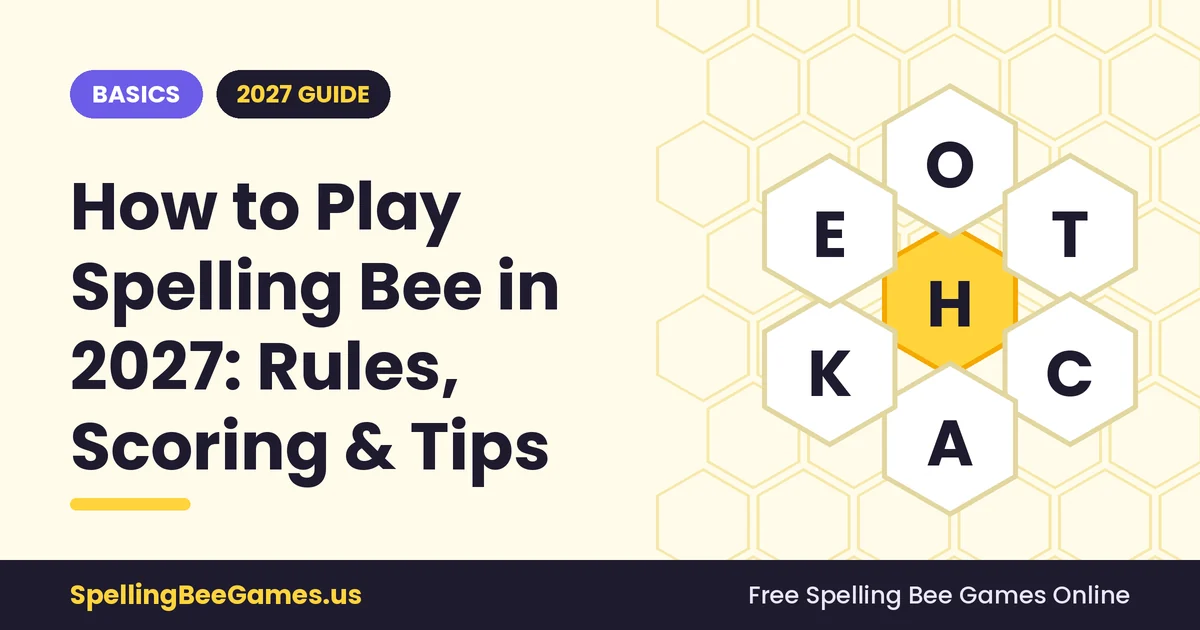
Here's a real puzzle from our library: center letter H, outer letters A, C, E, K, O, T. It has 53 answers worth 212 points. Here is how a strong player attacks it:
- Quick four-letter words first: ACHE, EACH, ECHO, ETCH, HACK, HATE, HEAT, HOOK, OATH, THAT. That's ten points and a feel for the letters.
- Stretch with doubled letters: HATCH, CATCH, TEETH, TOOTH, THATCH, HOOCH. Each is worth 5 or 6 points.
- Look for compounds: HATCHET, HOECAKE, HATCHECK and TOOTHACHE (9 points on its own).
- Find the pangram: it needs H, A, C, E, K, O and T. A "hot" food you can stack is HOTCAKE, worth 14 points.
This one example shows the whole game: easy short words, doubled letters, compounds, then the pangram. You can solve the same board yourself in the solver to check the full list.
10 Tips to Get Better at Spelling Bee
- Go letter by letter. Spend a minute on each starting letter: words beginning with A, then C, then E, and so on.
- Hunt the endings. ‑ED, ‑ER, ‑ING, ‑TION, ‑LY and ‑ABLE turn one root into several answers.
- Try the prefixes. RE‑, UN‑, DE‑, IN‑ and PRE‑ open whole families. Our prefixes and suffixes guide lists the most useful ones.
- Double up. Repeated letters hide easy words: LOLL, TOOT, COCOA, TEETH.
- Find the pangram early. It's worth the most points, and it often unlocks related words.
- Shuffle often. A new layout breaks old patterns.
- Think in categories. Foods, animals, body parts, tools and verbs of motion are common answer themes.
- Take a break. Coming back after ten minutes often reveals two or three "obvious" words.
- Use hints in order. Hint grid first, then the two-letter list, then single reveals. See today's hints.
- Review your misses. After each game, check the words you missed. They'll come up again.
Common Beginner Mistakes
- Forgetting the center letter. It's the most common rejection. Check for the yellow letter before you press Enter.
- Chasing rare words. The list favors everyday words, so try common ones before obscure ones.
- Ignoring plurals and verb forms. When S is on the board (it is on about 38% of our puzzles), plurals and ‑S verbs add a lot of points.
- Stopping at one pangram. About 40% of our boards have two or more pangrams.
- Using the solver too early. Seeing the answers first takes away most of the learning.
Daily Puzzle vs. Unlimited: Which Should You Play?
Play the daily puzzle when you want a shared challenge. Everyone gets the same letters, so you can compare scores with friends, and the hints page has help ready if you get stuck. Play unlimited when you want practice volume: ten boards in a row teaches patterns much faster than one board a day. Many players do both: the daily puzzle with morning coffee, and a few unlimited boards in the evening.
Is Spelling Bee Good for Learning?
Yes, especially for vocabulary and spelling patterns. Because every answer is built from the same seven letters, you start to notice how English words share roots and endings. Teachers use the game for warm-ups, and adults use it as a daily brain workout. For structured study, pair it with our spelling bee words by grade lists and a spelling bee practice routine.
Put it into practice: today's puzzle is waiting, and Unlimited has 3,700+ more.
Play Spelling Bee FreeFrequently Asked Questions
What are the rules of Spelling Bee?
Make words from the seven letters in the honeycomb. Each word must be at least four letters long, must contain the center letter, and can reuse letters. Proper nouns, hyphenated words and offensive words don't count.
How do you score points in Spelling Bee?
A four-letter word is worth 1 point. Words with five or more letters score 1 point per letter. A pangram, a word that uses all seven letters, adds a 7-point bonus, so a seven-letter pangram is worth 14 points.
What is a pangram in Spelling Bee?
A pangram is a word that uses every one of the seven letters at least once. Every puzzle has at least one. A pangram that uses each letter exactly once (seven letters long) is called a perfect pangram.
Can you reuse letters in Spelling Bee?
Yes. Any letter, including the center letter, can be used as many times as you like. That is why words like COCOA or TEETH can be valid answers.
How do I reach Genius in Spelling Bee?
On SpellingBeeGames.us, Genius means finding every word on the board. In the NYT game Genius is 70% of the points. Find the pangram early, work through each starting letter, try common endings, and use the hint grid when you stall.
Can I play Spelling Bee for free?
Yes. The daily puzzle and Spelling Bee Unlimited on SpellingBeeGames.us are completely free, with no login and no rank limit. The NYT version lets non-subscribers play only part of each puzzle.
Why does Spelling Bee reject some words?
A word is rejected if it is shorter than four letters, misses the center letter, uses a letter that isn't in the hive, or isn't in the game's word list. Very obscure words, proper nouns and hyphenated words are left out on purpose.