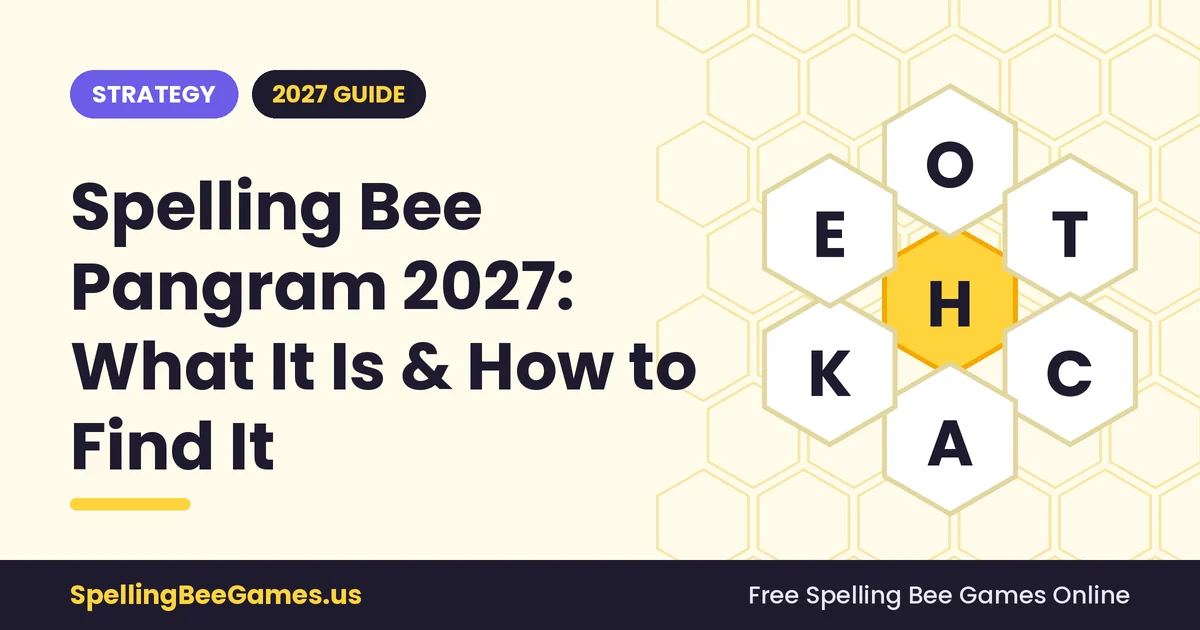
A Spelling Bee pangram is a word that uses all seven letters of the puzzle at least once, including the center letter. It scores 1 point per letter plus a 7-point bonus, so a seven-letter pangram is worth 14 points. Every puzzle has at least one. A perfect pangram uses each letter exactly once (7 letters total).
Key takeaways
- Pangram = all 7 letters at least once; perfect pangram = each letter exactly once.
- Points = word length + 7 bonus (HOTCAKE = 14, CRUNCHIER = 16).
- In our library, 40% of puzzles have two or more pangrams and 35% have a perfect one.
- 16% of pangrams end in -ING, so test that ending first whenever I, N and G are on the board.
What Is a Pangram in Spelling Bee?
In the Spelling Bee game, a pangram is a word that contains every one of the seven hive letters at least once. Because letters can repeat, a pangram is often longer than seven letters: MASTODONS uses M, A, S, T, O, D and N, with the O and S appearing twice.
Outside the game, "pangram" means a sentence that uses every letter of the alphabet, like The quick brown fox jumps over the lazy dog. Spelling Bee borrowed the word and shrank the alphabet to seven letters.
Pangram vs. Perfect Pangram
| Type | Rule | Example | Points |
|---|---|---|---|
| Pangram | All 7 letters, repeats allowed | CRUNCHIER (9 letters) | 9 + 7 = 16 |
| Perfect pangram | Each letter exactly once | HOTCAKE, BLAZING | 7 + 7 = 14 |
A perfect pangram is not worth extra points. It's just prettier and usually harder to see, because you can't lean on a repeated letter.
How Many Points Is a Pangram Worth?
The formula is simple: word length + 7. Normal words of five letters or more score one point per letter, and four-letter words score 1 point, so the pangram bonus is the biggest single bonus in the game.
| Pangram length | Score | Share of all pangrams (our library) |
|---|---|---|
| 7 letters | 14 | 23.1% |
| 8 letters | 15 | 32.8% |
| 9 letters | 16 | 24.8% |
| 10 letters | 17 | 12.0% |
| 11+ letters | 18+ | 7.2% |
On a typical board worth about 246 points, one pangram is roughly 6% of everything available. That's often enough to move you up a full rank on its own.
Does Every Puzzle Have a Pangram?
Yes. Spelling Bee boards are chosen so that at least one pangram exists, and our puzzles follow the same rule. Here's how pangrams are spread across our 3,782 puzzles:
| Pangrams on the board | Share of puzzles |
|---|---|
| 1 | 59.6% |
| 2 | 26.5% |
| 3 | 8.6% |
| 4 or more | 5.3% |
So when you find your first pangram, keep looking: four times in ten there's another one. Some boards hide whole families. One of ours has CLINGER, CLINGIER, ENCIRCLING and RECLINING; another has DEFYING, DEIFYING and EDIFYING.
Real Spelling Bee Pangram Examples
- HOTCAKE: center H; letters A C E K O T (perfect pangram)
- BLAZING: center G; letters A B I L N Z (perfect pangram)
- CRUNCHIER: center C; letters E H I N R U (9 letters)
- MASTODON, MASTODONS: center N; letters A D M O S T (two pangrams)
- ACOUSTIC, ACOUSTICS, CAUTIOUS: center I; letters A C O S T U (three pangrams)
Want to test yourself? Each example can be checked in the Spelling Bee solver.
What Pangrams Look Like: Patterns From 6,178 Pangrams
We checked every pangram in our library for common endings and beginnings. Endings matter far more than beginnings:
| Ending | Share of pangrams | Example |
|---|---|---|
| ‑ING | 16.0% | BLAZING, DEFYING |
| ‑ED | 7.5% | HARROWED |
| ‑LY | 6.0% | (adverbs like ‑FULLY, ‑ABLY) |
| ‑ER | 4.4% | CLINGER |
| ‑AL, ‑TION, ‑ITY | about 2% each | (nouns and adjectives) |
The top prefixes were IN‑ (2.9%), UN‑ (2.6%), RE‑ and DE‑ (1.4% each). The lesson: whenever I, N and G are all on the board, try ‑ING first. Roughly one pangram in six ends that way.
7 Proven Ways to Find the Pangram Faster
- Check the ending letters. I+N+G? Try ‑ING words. E+D? Try ‑ED. L+Y? Try ‑LY. Then fit the other four letters in front.
- Start from the rarest letter. Letters like Z, X, J, K, V or W limit the options, so the pangram usually grows around them (BLAZING, HOTCAKE).
- Stretch your longest word. If you found TOOTH, ask what can be added to use the missing letters (TOOTHACHE uses six, then HOTCAKE uses all seven).
- Try prefixes. IN‑, UN‑, RE‑, DE‑, MIS‑, OVER‑ and OUT‑ attach to almost anything.
- Think compounds. Two short words often make a pangram: HEAD + WORD = HEADWORD, HOT + CAKE = HOTCAKE.
- Shuffle, then read the outer ring aloud. New neighbors suggest new syllables.
- Use a light hint. The first letter and the length are usually enough. Today's are on our hints page.
Pangram Hints Without Spoilers
If you want help but not the answer, use these hints in order:
- Count: how many pangrams are on the board?
- First letter: which letter does the pangram start with?
- Length: is it a 7-letter perfect pangram or longer?
- Two-letter start: the first two letters narrow it down a lot.
- Reveal: show the word.
Our daily Spelling Bee hints page follows exactly this order, so you choose how much help you get.
Pangram vs. "Bingo"
Some players also chase a "bingo": finding at least one word that starts with each of the seven letters. A bingo isn't scored and isn't possible on every board, but it's a good self-challenge because it forces you to work letter by letter, which is the best general Spelling Bee strategy anyway.
Why Pangrams Matter for Ranks
On SpellingBeeGames.us, Genius means finding every word, so you can't reach it without every pangram. Even on the way up, the pangram often makes the difference between Nice and Great. The players who reach the top ranks most often treat the pangram as their first goal. Read the full plan in our Queen Bee and Genius strategy guide.
Practice Pangrams for Free
The fastest way to improve is volume. Play the daily puzzle, then a few boards of Spelling Bee Unlimited, and after each one check what you missed in the solver. For more word-building patterns, read Spelling Bee prefixes and suffixes.
Put it into practice: today's puzzle is waiting, and Unlimited has 3,700+ more.
Play Spelling Bee FreeFrequently Asked Questions
What is a pangram in Spelling Bee?
A pangram is a word that uses every one of the puzzle's seven letters at least once, including the center letter. Letters can repeat, so a pangram can be longer than seven letters. It earns a 7-point bonus on top of its length score.
How many points is a pangram worth in Spelling Bee?
A pangram scores 1 point per letter plus a 7-point bonus. A seven-letter pangram is worth 14 points, an eight-letter pangram 15, and a nine-letter pangram such as CRUNCHIER 16.
What is a perfect pangram?
A perfect pangram uses each of the seven letters exactly once, so it is exactly seven letters long, like HOTCAKE or BLAZING. In our puzzle library, about 35% of boards have at least one perfect pangram.
Does every Spelling Bee puzzle have a pangram?
Yes. Spelling Bee boards are built so that at least one pangram exists. In our library of 3,782 puzzles, 59.6% have exactly one pangram and 40.4% have two or more.
Can there be more than one pangram?
Yes. About 27% of our puzzles have two pangrams, and around 14% have three or more. The record in our library is 11 pangrams on a single board.
What is today's Spelling Bee pangram?
For the daily puzzle on SpellingBeeGames.us, open today's hints page. It gives the pangram's first letter and length first, and you can reveal the full word with one tap.
How do I find the pangram faster?
Test common endings first (-ING, -ED, -LY, -ER), add prefixes like IN-, UN- and RE-, build on the long words you have already found, and shuffle the hive often. Starting with the rarest letter also helps.