
Greek and Latin roots are word parts with fixed meanings, such as graph (write), bio (life) and port (carry). Most hard spelling bee words are built from them. Learn the root, its meaning and its usual spelling, and you can spell unfamiliar words by breaking them into parts.
Key takeaways
- Roots turn one memorized word into a whole family of words.
- Greek and Latin words follow different spelling habits; the language of origin is a strong clue.
- Learn five roots a week with three example words each.
- Always ask the pronouncer for the language of origin and definition.
Why Roots Matter in a Spelling Bee
From the regional level up, spellers hear words they have never seen. Champions handle them by thinking, "What parts is this word made of?" A word like hydrophobia becomes hydro (water) + phob (fear) + -ia (condition). Once you know the parts, the spelling follows.
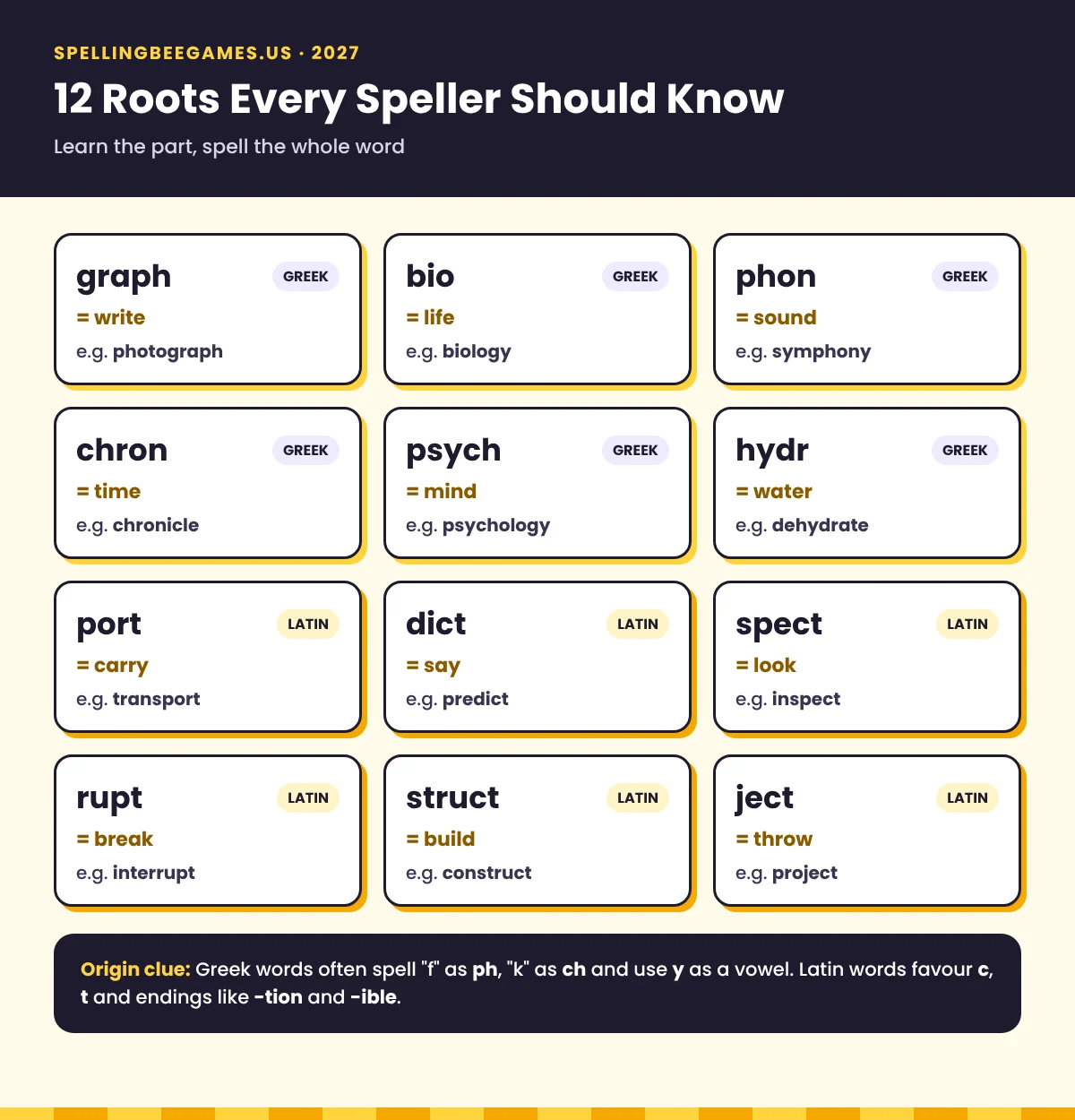
Greek Roots for Spelling Bee
| Root | Meaning | Example words |
|---|---|---|
| auto | self | autograph, autonomy |
| bio | life | biology, biography |
| chron | time | chronicle, synchronize |
| cracy / crat | rule | democracy, aristocrat |
| geo | earth | geography, geology |
| graph / gram | write, draw | paragraph, telegram |
| hydr | water | hydrant, dehydrate |
| logy | study of | zoology, etymology |
| micro | small | microscope, microbe |
| morph | shape | metamorphosis, amorphous |
| path | feeling, disease | sympathy, pathology |
| phil | love | philosophy, bibliophile |
| phob | fear | claustrophobia, phobic |
| phon | sound | symphony, phonics |
| photo / phos | light | photograph, phosphorus |
| psych | mind | psychology, psychic |
| scope | look at | telescope, horoscope |
| tele | far | telephone, telepathy |
| therm | heat | thermometer, thermal |
| psammo | sand | psammophile (2023 winning word) |
Latin Roots for Spelling Bee
| Root | Meaning | Example words |
|---|---|---|
| aqua / aque | water | aquarium, aqueduct |
| aud | hear | audible, auditorium |
| bene | good, well | benefit, benevolent |
| cred | believe | credible, incredulous |
| dict | say | predict, contradict |
| duc / duct | lead | conduct, educate |
| fract / frag | break | fracture, fragile |
| ject | throw | project, trajectory |
| junct | join | junction, conjunction |
| mal | bad | malfunction, malevolent |
| mit / miss | send | transmit, missile |
| port | carry | transport, portable |
| rupt | break | erupt, interrupt |
| scrib / script | write | inscribe, manuscript |
| spec / spect | look | inspect, spectacle |
| struct | build | construct, infrastructure |
| tract | pull, drag | tractor, distract |
| vid / vis | see | evidence, visible |
| voc / vok | call, voice | vocal, provoke |
| volv / volut | roll, turn | revolve, evolution |
Spelling Clues by Language of Origin
| Sound or feature | Greek words often use | Latin words often use |
|---|---|---|
| "f" sound | ph (phobia) | f (fracture) |
| "k" sound | ch or k (chronic, kinetic) | c (conduct) |
| "i" vowel in the middle | y (symphony, rhythm) | i (visible) |
| Silent first letter | ps, pn, pt (psychology, pneumonia, pterodactyl) | rare |
| Common endings | -ology, -itis, -ism, -ize | -tion, -ous, -ible, -ent |
These are patterns, not laws, but they turn a 50-50 guess into a confident answer. For the spelling rules behind suffixes, see our prefixes and suffixes guide and 12 spelling rules that fix most mistakes.
Prefixes and Suffixes That Pair With Roots
Roots rarely appear alone. Most bee words wrap a root in a prefix, a suffix or both. Learn these and you can take apart almost any long word.
| Part | Meaning | Example |
|---|---|---|
| a- / an- (Greek) | not, without | amorphous, anonymous |
| sym- / syn- (Greek) | together | symphony, synchronize |
| inter- (Latin) | between | interrupt, international |
| trans- (Latin) | across | transport, transmit |
| -itis (Greek) | inflammation | tonsillitis, arthritis |
| -phile (Greek) | lover of | bibliophile, psammophile |
| -ible / -able (Latin) | able to be | visible, portable |
| -ous (Latin) | full of | courageous, malicious |
Try it: in + spect + ion = inspection. bio + graph + y = biography. tele + path + y = telepathy. Once you see the pattern, you will spot it in every long word.
Beyond Greek and Latin: Other Origins to Know
Later rounds use words from many languages. A few patterns help:
- French: endings like -eau, -ette, -ique and silent final letters (plateau, silhouette, boutique).
- German: sch, -ei- for the "eye" sound (schnauzer, poltergeist, kindergarten).
- Italian: double consonants and final vowels (spaghetti, staccato).
- Spanish: ll and -ado / -illo endings (tortilla, armadillo).
Always ask the pronouncer for the language of origin. It is one of the most useful questions you are allowed to ask.
How to Practice Roots
- Five roots a week. Write each root, its meaning and three example words.
- Build a word web. Put the root in the middle and add every word you can think of around it.
- Split hard words. When you meet a new word, mark its parts with slashes: tele / scope.
- Quiz by origin. Have a parent read a word and its language of origin; you name the root before spelling.
- Mix in games. Long answers in Spelling Bee Unlimited are often root words with prefixes and suffixes added.
Getting ready for a school or regional bee? Our Scripps National Spelling Bee 2027 guide covers the dates, study lists and a season prep plan, and the hardest spelling bee words guide groups tricky words by the trap they set.
Put your roots to work. Long words score big in today's puzzle.
Play Spelling Bee freeFrequently Asked Questions
Why do roots help in a spelling bee?
Most hard bee words are built from Greek or Latin parts. If you know that graph means write and photo means light, you can spell photograph-style words you have never studied.
How do I know if a word is Greek or Latin?
Ask for the language of origin. Greek words often use ph for the f sound, ch for k, y as a vowel and endings like -ology and -itis. Latin words often use c and t, and endings like -tion, -ous and -ible.
How many roots should I learn for a spelling bee?
Start with the 40 roots in this guide. Strong regional spellers often know 150 to 300 roots and patterns, added a few at a time.
Can I ask the pronouncer for the root of a word?
In most bees you can ask for the definition, part of speech, a sentence, the language of origin and alternate pronunciations. Many bees also let you ask whether a word comes from a specific root.